Sudan has been gripped by a brutal civil war that has divided the country and caused one of the world’s worst humanitarian crises. Reports say the Rapid Support Forces, or RSF, killed more than 400 people at a hospital in el-Fasher in Darfur this week.
Yale’s Humanitarian Research Lab has been tracking the conflict for years. “In July of 2023, we warned the UN Security Council that el-Fasher would come under siege and would result in the mass slaughter we are seeing now,” Nathaniel Raymond, executive director of the lab at Yale School of Public Health, told Newsweek. Humanitarian and research groups have repeatedly warned that violence was escalating in an already unstable region.
Sudan’s civil war has deep roots, going back to the colonial era and the Darfur War of 2003. But the current conflict ignited in April 2023, after years of tension between Sudan’s two main military factions: the RSF and the Sudanese Armed Forces, or SAF. The RSF traces its origins to militias integrated during the rule of former President Omar al-Bashir. Mohamed Hamdan Dagalo, a leader in the RSF, initially supported President Abdel Fattah al-Burhan’s government but later became a key opponent.
By April 15, 2023, tensions exploded into full-scale civil war. RSF forces attacked military positions, seized parts of Khartoum, and spread into smaller cities. While the RSF were pushed out of the capital earlier this year, they have entrenched elsewhere, with their recent victory in Darfur effectively dividing Sudan in two. Sudan previously split in 2011 when South Sudan seceded. The border remains disputed, and the separation has added to instability.
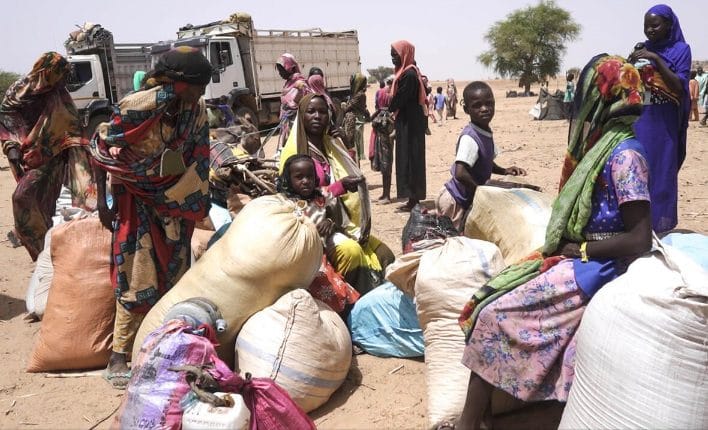
The humanitarian crisis is staggering. The UN says more than 30 million people need urgent humanitarian aid. Aid groups estimate at least 150,000 people have died, while the Associated Press reports around 40,000 fatalities. Millions have been displaced. Zamzam camp near el-Fasher hosts more than half a million internally displaced people. Food, water, and medical aid have been severely disrupted due to blockades and attacks by RSF forces.
“The number of people who made it to Tawila is very small and that should be a concern for all of us,” Mathilde Vu, advocacy manager for the Norwegian Refugee Council, told AP. “Where are the others? That tells the horror of the journey.”
The World Health Organization reported 460 patients and affiliates were killed at the Saudi Hospital in el-Fasher this week. Yale’s Humanitarian Research Lab said RSF fighters carried out “systematic killings” and attacked hospitals and aid workers in ways that could amount to war crimes. RSF commander Dagalo has acknowledged “abuses” but gave no details. Before this assault, at least 1,850 civilians had already died in North Darfur this year, including 1,350 in el-Fasher alone, according to UN figures.
The region has also been battered by drought and flooding, worsening food insecurity and living conditions. The UN says Sudan now hosts the world’s largest child displacement crisis. Reports suggest the United Arab Emirates has supplied weapons and drones to RSF forces.
Alex de Waal, executive director of Tufts University’s World Peace Foundation, said, “Since the earliest days of the current war, it has been clear that the road to peace ran through Arab capitals, particularly Cairo, Riyadh and Abu Dhabi. The belligerents cannot pursue the war at scale without external support and stemming that support is a precondition for making progress.”
David Miliband, president of the International Rescue Committee, warned, “The fact that we are seeing so few people arriving safely in Tawila should alarm everyone. Safe passage for civilians must be guaranteed, aid must be scaled up and funded now, and all parties must respect their obligation to protect civilians. The world cannot turn away from yet another chapter of horror in Darfur.”
Featured image via Youtube screengrab