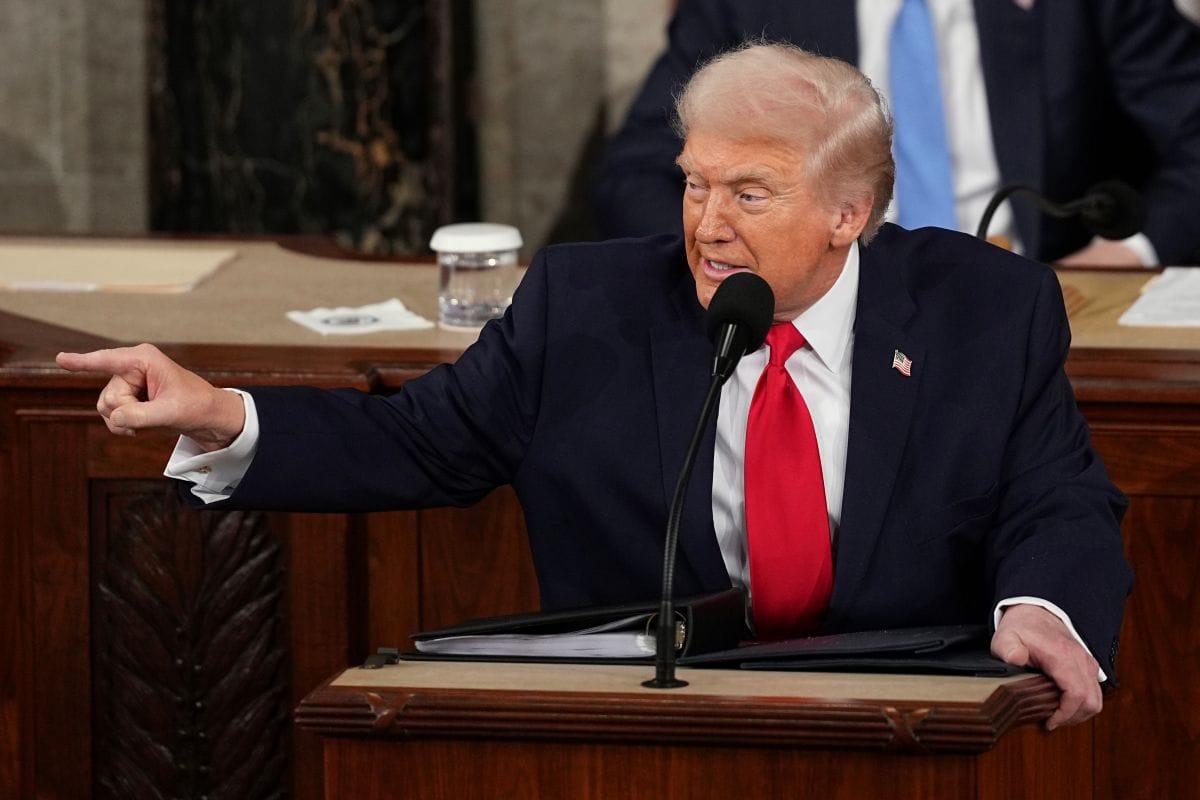
In the first State of the Union address of his second term, Donald Trump declared that “our nation is back, bigger, better, richer and stronger than ever before,” telling lawmakers, “What a difference a president makes.” He added, “A short time ago, we were a dead country. Now we are the hottest country anywhere in the world.”
The prime-time speech laid out a sweeping portrait of economic revival, border security gains and global strength. But a review by CNN and other fact-checking outlets found that several of the president’s claims stretched or contradicted publicly available data.
On the economy, Trump said he inherited “a stagnant economy” with “inflation at record levels.” Federal data show annual real GDP growth was at or above 2.5% in each year under Joe Biden, and inflation had cooled to roughly 3% when Trump took office, down from a 9.1% peak in 2022. Trump went on to say the economy “is roaring like never before,” though federal estimates put 2025 growth at 2.2%, lower than the prior two years. The unemployment rate has ticked up slightly during his first year back in office.
He also argued that prices are “plummeting downward.” While the rate of inflation has declined, prices overall continue to rise, albeit more slowly. Trump’s statement that “more Americans are working today than at any time in the history of our country” is accurate in raw numbers, but economists note that population growth makes such comparisons less straightforward.
On consumer costs, Trump claimed Americans “will now pay the lowest price anywhere in the world for drugs.” His administration has negotiated lower prices for certain medications in specific programs, but there is no broad evidence that U.S. drug prices now rank among the world’s lowest. He similarly asserted that gasoline prices are “now below $2.30 a gallon in most states,” though the nationwide average stood at $2.94, and no state average was below $2.30 at the time of the address.
White House records list total public and private investment commitments at $9.7 trillion — roughly half of the $18 trillion figure cited in the speech. NBC News reported that several announced investments either increased only marginally or were “in line with previous plans,” and noted that “many of the commitments are also over the long term and are likely to be subject to change.” A Bloomberg Economics analysis further described the White House’s running total as inflated as of late 2025.He also said the flow of fentanyl across the border was down “by a record 56%,” a statistic not supported by detailed federal breakdowns.
On immigration, Trump again alleged that many migrants came from “prisons” and “mental institutions” and that the previous administration admitted “11,888 murderers.” Fact-checkers found no public evidence supporting those figures.
He further insisted, without presenting proof, that “cheating is rampant in our elections,” and called for legislation “to stop illegal aliens” from voting, despite studies showing such voting is rare.
Turning to fiscal policy, Trump suggested the federal budget could be balanced “if we’re able to find enough of that fraud.” The most recent deficit was approximately $1.8 trillion, far exceeding official estimates of annual losses to fraud. He also argued that tariffs could eventually replace income taxes — a proposition many economists have questioned.
On foreign policy, Trump said the U.S. “obliterated Iran’s nuclear weapons program” last year. Nuclear experts have said the program was damaged but not destroyed. He further claimed to have ended “eight wars,” though independent tallies vary on how such conflicts are defined.
As with past addresses, the speech blended policy announcements, political messaging and sweeping declarations. Fact-checking organizations continue to review the full text, parsing what was verifiable, what lacked context and what remains disputed in the broader public debate.
Featured image by Matt Rourke/ AP