President Donald Trump’s approval rating on foreign policy has fallen to its lowest point since he returned to office for a second term, according to new national polling.
The numbers suggest voters are uneasy with how the United States is handling the world stage, from military action in Venezuela to Trump’s renewed interest in Greenland. Yes, Greenland. Again.
A Marist Poll conducted January 12 to 13 found that just 37% of adults approve of Trump’s handling of foreign policy. 56% disapprove, while 7% are unsure.
That marks Trump’s weakest foreign policy showing in this polling series, down from 41% in July 2025 and 39% in April 2025. The trend line is clear and it is not going up.
For comparison, former President Joe Biden also struggled on foreign policy approval later in his term. But his early numbers were stronger, suggesting Trump started lower and slid faster. Not exactly a comforting chart for the White House briefing room.
The Marist survey questioned 1,408 adults using phone, text, and online responses. The margin of error was plus or minus 3.3 points, and the data were weighted to reflect the national population.
The Marist results are not an outlier. Other major polls show similar frustration among voters, meaning this is not just one survey ruining the president’s morning coffee.
An AP NORC poll conducted January 8 to 11 found about six in ten Americans disapprove of Trump’s foreign policy. In the same poll, 56% said Trump had “gone too far” in using the US military abroad.
That survey included 1,203 adults and had a margin of error of plus or minus 3.9 points. The findings line up neatly with Marist, which is polling code for “this is probably real.”
An Economist YouGov poll from January 9 to 12 found 39% approval and 50% disapproval, with 11% unsure. That gave Trump a net rating of -11 points. That poll surveyed 1,602 adults and carried a margin of error of plus or minus 3.3 points. Again, not exactly a victory lap.
White House spokesperson Anna Kelly defended the president’s approach in comments to Newsweek. “President Trump was not elected to preserve the status quo—he is a visionary leader who is always generating creative ideas to bolster U.S. national security.
“Many of this president’s predecessors recognized the strategic logic of acquiring Greenland, but only President Trump has had the courage to pursue this idea seriously.
“As the president said, NATO becomes far more formidable and effective with Greenland in the hands of the United States, and Greenlanders would be better served if protected by the United States from modern threats in the Arctic region.”
Charles Kupchan, a senior fellow at the Council on Foreign Relations and professor at Georgetown University, said: “The U.S. electorate understandably soured on the hyperglobalization and strategic overreach that set in during the 1900s, clearing the way for the Trump era.
“But Trump has dramatically overcorrected. His America First foreign policy is out of step with geopolitical realities, opening up a wide gap between his neo-isolationist rhetoric and his neo-imperial policies. His immoral crackdown on immigration is disrupting labor markets, while his tariffs only exacerbate economic insecurity for working families. Not surprisingly, Trump’s political support is cratering.”
Marc Weller, director of the International Law Programme at Chatham House, also warned that Trump’s approach risks long term damage to alliances.
“The united and strong European response to US threats against Denmark – a brand leader in compliance with international law along with other Nordic states – offers an indication that others remain committed to the international rule of law and will, eventually, be willing to speak up in favour of an international system governed by rules and principles that by and large yield stability and security for all, whether weak or strong.
“In opting out of this consensus, the US risks assuming the position of a rogue state within the international system. It seems unlikely that Denmark, or others, will in the future be keen to come to agreements or settlements with a state that so openly claims the right to disregard what has been agreed as a matter of law.”
The White House says Trump’s policies project strength and protect national interests. Critics say they project chaos and create new fires where there were mostly smoke alarms.
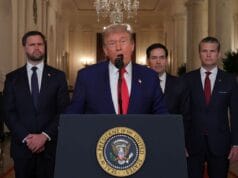
Featured image via X screengrab