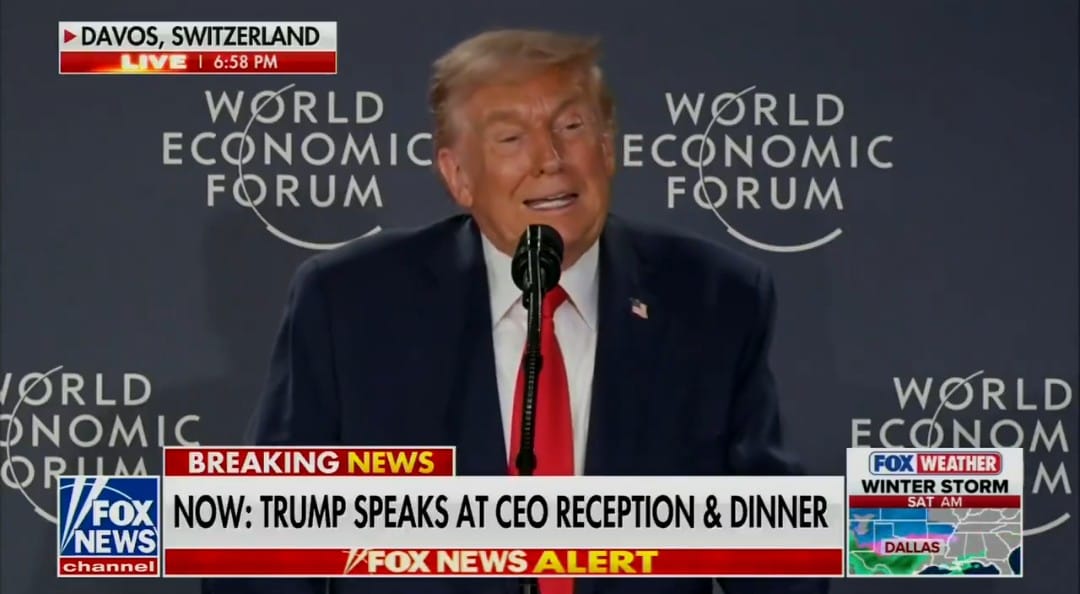
President Donald Trump stood before a wealthy global audience in Davos and delivered a line that would once have ended a political career.
During a closed meeting with chief executives at the World Economic Forum, he boasted, “we got great reviews,” and then said the quiet part out loud: “Usually they say, ‘He’s a horrible dictator type person,’ I’m a dictator,” Trump said. “But sometimes you need a dictator.”
Trump: “Usually they say, ‘he’s a horrible dictator-type person.’ But sometimes you need a dictator.” pic.twitter.com/Mi11DZx0u3
— Aaron Rupar (@atrupar) January 21, 2026
The president did not explain when dictators are needed or who decides when freedom should be set aside. He did not frame the comment as a joke. He simply said it and moved on, as if describing a management style rather than the collapse of democratic rule.
The remark came during Trump’s appearance at the World Economic Forum, a gathering known for cautious language and polished speeches. His talk drew mixed reactions inside the room, but the comment about dictatorship barely registered in the immediate coverage.
That it did not says less about the statement itself and more about how accustomed the country has become to Trump openly expressing contempt for democracy. When a sitting president says dictators are sometimes preferable, the shock fades only because the audience has been trained to expect it.
Trump later suggested that he had defied expectations. He framed himself as misunderstood, once again portraying critics as hysterical and himself as honest. The line played into his long running habit of turning accusations into branding and then daring anyone to stop him.
This is not an isolated moment. Trump has repeatedly flirted with authoritarian language. He has talked about leading a temporary dictatorship. He has shared images of himself wearing a crown. He has declared that “he who saves his country violates no law.” He has floated the idea of terminating parts of the Constitution. He has joked about canceling elections.
He has also made clear that his admiration for dictators abroad is not accidental. He praises them for their control, their loyalty tests, and their ability to crush opposition. This is not policy analysis. It is envy.
For years, some supporters argued that critics were overreacting, that Trump was exaggerating, joking, or provoking the media. But his own words have steadily erased that defense. He is not being subtle. He is not being ironic. He is explaining how he views power.
The Davos comment matters because it confirms a worldview. Trump believes freedom is conditional. He believes laws are obstacles. He believes legitimacy comes from personal will rather than public consent. When he says “sometimes you need a dictator,” he is placing himself in that role.
What makes the moment more disturbing is how easily it passed. The comment was overshadowed by other gaffes, including factual errors and confused remarks during the same appearance.
Legal scholars and democracy advocates warned that normalizing this language carries consequences. When leaders praise unchecked power, institutions weaken. When voters hear it often enough, it starts to sound ordinary. That is how democratic erosion works. Slowly, then all at once.
Trump’s defenders continue to argue that results matter more than process. That speed is more important than rights. That order justifies control. History offers a long and bloody record of where that thinking leads.
Online reaction was swift and blunt.
Here are the facts. Trump couped the US government. The people reelected him in spite of that. It tells you that our people are sick. That is the root of the problem that must be dealt with before anyone ever removes him.
— Harris Peskin for democracy (@HarrisPeskin) January 21, 2026
No one wants dementia grandpa to be a fucking dictator
— Sycamore’s Source (@sycamoressource) January 21, 2026
No, you dont need a dictator unless your goal is destroying America
— Manna (@OhMyManna) January 21, 2026
Trump is now saying the quiet part out loud.
— Denison Barb (@DenisonBarbs) January 21, 2026
— KeepCalmandVOTE 🛹☮️ 🪁✌🏼 (@keepcalm_BetoOn) January 21, 2026
Does he know that’s the “World Economics Forum”? Does he even know where he is?
— DQ 🛼🛼🪩🎖️ (@D4nciingQueen) January 21, 2026
He’s not even hiding it!
— Lucas Sanders 👊🏽🔥🇺🇸 (@LucasSa56947288) January 21, 2026
What “great reviews”? The whole world listened stupefied at his incoherent rambling. You really have to wonder about the things Trump’s entourage keeps from him. They showed him the “great reviews” by far-right MAGA influencers.
— Matthew Fraser 🇪🇺 (@frasermatthew) January 21, 2026
Featured image via X screengrab