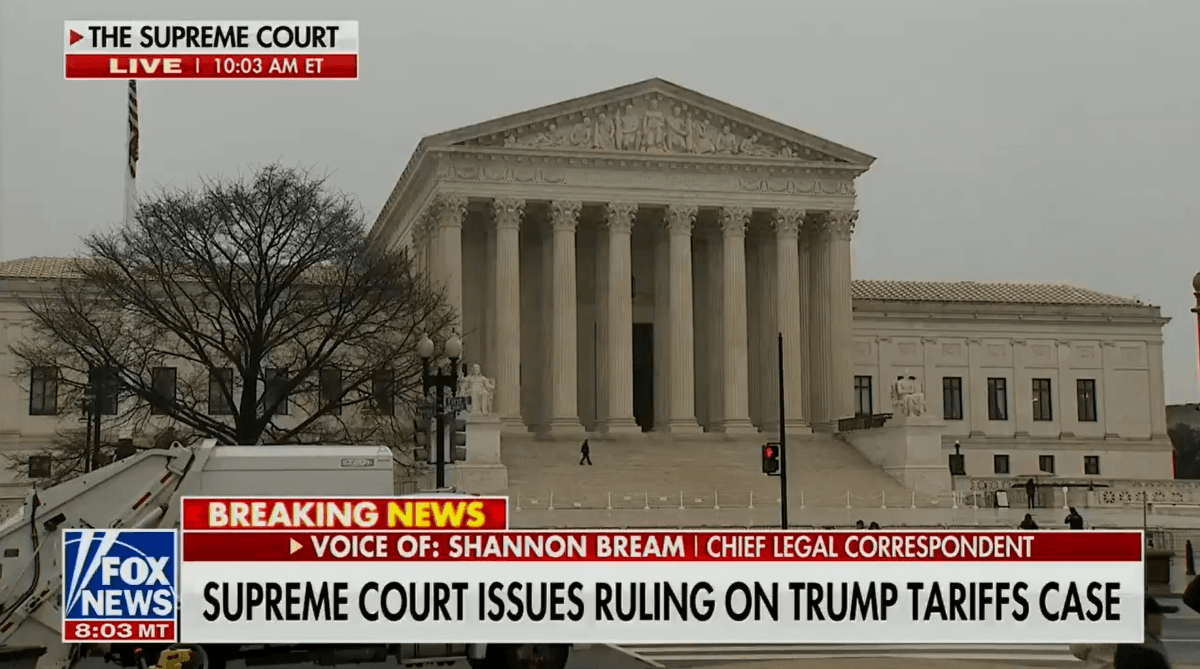
The United States Supreme Court dealt a stunning blow to President Donald Trump’s trade agenda on February 20, 2026, when a 6–3 majority held that the president lacked constitutional authority to impose sweeping global tariffs under the International Emergency Economic Powers Act (IEEPA).
Chief Justice John Roberts — writing for the majority — wrote that “the Constitution very clearly gives Congress the power to impose taxes, which include tariffs,” and that IEEPA did not transfer that core authority to the executive branch.
Roberts explained that although the 1977 statute allows a president to act during national emergencies, “IEEPA’s grant of authority to ‘regulate … importation’ falls short” of letting the executive create broad-based tariff regimes without Congress’s explicit direction.
The opinion underscored a constitutional bedrock: Article I, Section 8 assigns tariff and tax powers to Congress, and presidential imposition of import levies on a global scale crosses that line unless Congress legislates otherwise.
For Trump’s team, this ruling marks a rare legal setback. The administration argued that persistent trade deficits, global supply chain fragilities, and unfair trading practices justified invoking a national economic emergency, but the Court was unpersuaded. “The president enjoys no inherent authority to impose tariffs during peacetime,” the majority noted, quoting the Trump administration’s own concession.
Economically, tariffs have been central to Trump’s second-term strategy. His team projected they would reduce the U.S. trade deficit — which remained near record levels in 2025, even as tariffs intensified — and pressure trading partners like China into more favorable deals.
Yet the costs were palpably felt. European Union officials warned that retaliatory measures were already in motion before the ruling, and stock markets swung sharply as global investors re-priced risk on tariff uncertainty and supply chain disruption.
The dissent, delivered by conservative justices Clarence Thomas, Samuel Alito, and Brett Kavanaugh, faulted the decision for majorly restricting executive power in foreign affairs. “This Court substitutes its judgment for that of the political branches in matters touching foreign affairs and national security,” one dissenting vote maintained.
Aside from constitutional questions, the ruling also raises complex financial issues. Trump’s emergency tariffs had generated an estimated $133 billion in duty revenue before the decision; companies and importers are now eyeing refunds, and legal battles over compensation are expected to unfold.
Political fallout was immediate. President Donald Trump blasted the ruling as a “disgrace” in comments amplified across social platforms, according to Times of India’s live reaction roundup. Reuters noted cautious responses from foreign officials, with the UK signaling continued trade ties, while Bloomberg reported Wall Street reacting sharply as traders weighed tariff and policy impacts.
JONATHAN TURLEY: “There’s a lot of runway still for the administration…”
“The administration has other tools in its toolbox. It CAN actually impose tariffs under other statutes!”
— d0u6 (@d0u6s) February 20, 2026
The US Supreme Court has just STRUCK DOWN President Trump’s tariff authority, 6-3.
China is celebrating! All China wanted is to delay tariffs until POTUS is out. All this does is delay the approach to negotiate with China who doesn’t have America’s best interest in mind.
I…
— Patrick Bet-David (@patrickbetdavid) February 20, 2026
President Trump has other tariff powers. pic.twitter.com/4Sq5SJWbxV
— LiveLife 🇺🇸 (@livelifekaye) February 20, 2026
Markets reacted across multiple sectors as traders recalibrated expectations for consumer prices, corporate margins, and longer-term trade policy. Analysts noted that removal of broad tariffs could eventually ease inflationary pressures on consumer goods — but cautioned that broader geopolitical tensions still cloud the outlook.
The Supreme Court of the United States signaled that tariff power is legislative, not executive. Invoking the International Emergency Economic Powers Act does not permit a president to redesign national trade policy by proclamation. Under the Constitution, duties and taxes originate in Congress, and structural shifts in tariff policy require congressional authorization, not emergency framing.
Featured image via X screengrab






[…] Trump exploded into the White House briefing room with anger and a plan on Friday after the court stripped away most of his tariff program. He called the ruling a “disgrace to our nation” and accused […]
[…] have been a routine check became a clash. The White House reacted swiftly after the Supreme Court struck down Trump’s sweeping global tariffs in a 6–3 ruling for exceeding his 1977 emergency powers. Within […]
[…] and at home. The focal point is ongoing tension over trade policy after the U.S. Supreme Court struck down parts of Trump’s tariff program and the administration responded with a new global tariff, […]
[…] Supreme Court, in a 6-3 decision, held that the International Emergency Economic Powers Act (IEEPA) does not […]
[…] court ruled on Friday that the law the administration used did not allow the tariffs it had imposed. The […]