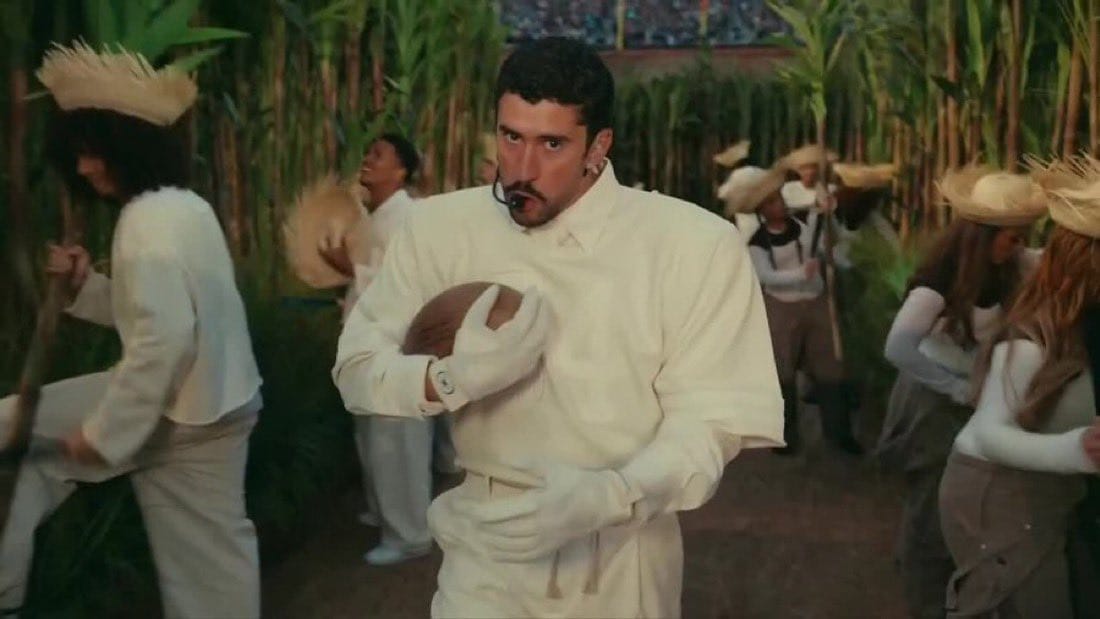
When NBC Sports announced the viewership numbers for Super Bowl LX on X, the data looked almost too good to be true — and for some, it was. The network reported that Bad Bunny’s halftime performance averaged 128.2 million viewers over its 15‑minute run, topping the game’s own average of 124.9 million viewers and even peaking at 137.8 million total across platforms.
On the surface, those numbers sound like another era‑defining broadcast moment. But scratch a little deeper and you find the kind of skepticism that’s become part of any big cultural moment these days. Sure, the Bad Bunny halftime show delivered huge figures, and yes, NFL social media engagement reportedly hit record levels with about 4 billion views in the first 24 hours — but some viewers online are openly questioning whether the audience was really as massive as the networks suggested.
To understand why this matters, and why fans online are so divided, it helps to put the numbers in context. According to Nielsen’s Big Data + Panel measurement, Bad Bunny’s halftime viewership did indeed surpass the average for the overall Super Bowl broadcast. That’s a rare achievement: traditionally, the football game itself draws more consistent eyeballs than the entertainment break in the middle.
But the halftime show still fell short of breaking the all‑time halftime record. Last year’s Kendrick Lamar halftime show drew an average of 133.5 million viewers, and Michael Jackson’s iconic 1993 performance still sits near the top of the list. Bad Bunny’s figure, while massive, ranks fourth in Super Bowl history.
This is where the narrative gets interesting. Bad Bunny’s performance was almost entirely in Spanish and celebrated Latino culture with guest appearances and stylistic flourishes. Some social media voices embraced the cultural moment; others reacted with skepticism, claiming that stadium reactions looked muted or that portions of the audience were disengaged.
Well. That made me feel more proudly American than anything Kid Rock has ever done.
— K A C E Y (@KaceyMusgraves) February 9, 2026
On X, reactions ranged from celebratory to downright cynical, with users dissecting every frame of Levi’s Stadium footage and every decimal point of the Nielsen estimate.
So speaking in another language where 98% of Americans aren’t going to know one word of what he said made you “more proudly American?” WTF?! LOL
— Beyond Deception (@BeyondDeception) February 9, 2026
Donald Trump took to his Truth Social account shortly after the performance and blasted the show as “absolutely terrible, one of the worst, EVER,” calling it a “slap in the face to our country” and arguing that “nobody understands a word this guy is saying.”
The skepticism isn’t just about who watched — it’s also about how people are counted. The NFL and its partners now combine TV and digital metrics to produce a single figure, and that has critics wondering whether the numbers are apples‑to‑oranges comparisons.
Even among more traditional outlets, the take is measured: the Super Bowl broadcast as a whole averaged about 124.9 million viewers in the U.S., making it the second‑most watched Super Bowl ever, just behind the previous year’s game. The halftime metrics were strong, but not record‑breaking, and social media views — however large — don’t always translate into sustained attention.
Bad Bunny’s performance also came with its own cast of characters — appearances by Lady Gaga and Ricky Martin, plus a setlist that leaned into celebration rather than spectacle. That contrast with past halftime shows — some of which were designed to be cultural crucibles — adds another layer to how audiences are interpreting the data.
And if nothing else, the fact that the halftime show numbers generate more commentary than the actual game says as much about today’s media landscape as any Nielsen Black Box ever could.
Featured image via X screengrab